SUSPENDED: White River Junction, VT to Canaan, NH in N Scale
The Club's N scale layout depicting the portion of the B&M line (old
Northern Railroad) from White River Junction, Vermont across the Connecticut River to
Lebanon and ending (for the layout at least) at Canaan, New Hampshire had to
be disassembled because the Club's lease was terminated when the town sold
the old firehouse. Everything, including the intact helix, is being
stored in members homes, awaiting the chance to be assembled and operated!
We have plans to resurrect the layout in a new home, but first we must
find that new home. In the meantime, we'll leave the plans, images and
pages about the layout up here for you to see what might have been.
Immediately below are images of the layout design created by Jody Marsh and developed
through the work of many club members. The layout is to have three levels with the
lowest level for staging and all levels connected by a multi-track helix. It should
be noted that all spurs, passing tracks, and yards existing on the prototype have been
worked into this layout design. This design has been approved by the Club members
and we have started construction on the benchwork.
This layout will use
Digital Command Control (DCC) system. We just purchased our
system from
of Essex Junction, Vermont!
Scroll down below the layout design to see construction update
photos.
Level 1: Staging (click on thumbnails for 800x800 image).

Level 2: White River Junction, VT across Connecticut River to Westboro Yard in Lebanon,
NH.

Level 3: Top level with towns of Enfield and Canaan, NH.

Construction has begun! The first image shows The next images show us laying out and constructing the
helix. Click on the thumbnails to see a larger image.
| The basic plan for supporting the
extruded foam construction from the walls. Luan plywood brackets, stiffened with 1x1 and
1x2 strips will be added. |
 |
| Here, Spencer, Jody and Dave layout the helix and mark the floor for
the helix supports. |
 |
| Jody and Spencer place the blocks on the floor next to where the
helix support legs will be attached to ensure the proper support for
the helix. |
 |
| The support legs for the helix are being put in place according to
the marks and blocks. Each of the supports had be be just the right
height to provide a smooth grade on this first level. All the
other turns could be adjusted using the threaded rod and nut support
system, but that first level was the key. Get it right and the
rest would be smooth sailing. |
 |
| The helix subroadbed is constructed of two layers of luan plywood
arcs offset and held together using construction glue. The arcs
were cut out of 4x8 sheets of luan plywood. Each arc is about a
quarter of a circle. The dimensions for the helix were
determined and then drawn on the floor. |
 |
| The first level of the helix is complete! All went well. |
|
| And everyone stands around a while to admire it and marvel that it
came out correct! |
 |
| Here's a shot of that first level. |
 |
| More layers are completed. Each section was clamped and glued
to the preceding section using the unpainted single layer section
created by the overlap. |
 |
| The helix is complete! |
 |
| In between additions to the helix, while the glue was drying, we
turned our attention to the subroadbed for the staging yard. |
 |
It's been a while since I updated this webpage! In addition,
we've laid the tracks for the lower staging yards and we've built the
door/duck under that will allow the tracks to make a complete circuit around
the room while still allowing members to enter and leave without removing a
whole section of the layout.
| As you can see below, the helix is now complete, we've
laid the staging yard tracks on the first level and we've constructed
the door that allows the first two levels' tracks to make a complete
circuit around the room while still giving us a means to enter or
leave. |
 |
| This shows the staging yard tracks laid on sheet cork
and the point where the second level construction has halted for the
evening. |
 |
| Here are shots showing the door with bridge tracks for
the first and second levels (the third level will run above the door
creating a minimally low duck under). The door is hinged to open to the
inside of the room. It is a wood frame stiffened with a
plexiglass back (that allows someone outside the room to see if there
is a train on the tracks before opening the door). Eventually
we'll have a simple bolt lock on the inside so that someone entering
must have someone inside unbolt it before entry is possible.
We'll also wire the system with detectors to prevent trains from
running on the bridge when the door is open. |
 |
| The second level construction began with this curved
section representing Mascoma (old East Lebanon) and Mascoma
Lake. The lake was created by slicing the foam along the
"shore line" and then lowering and gluing it back in
place. We use some minimal luan plywood bracing attached with a
special ACC glue and sheetrock screws to hold this in place. |
 |
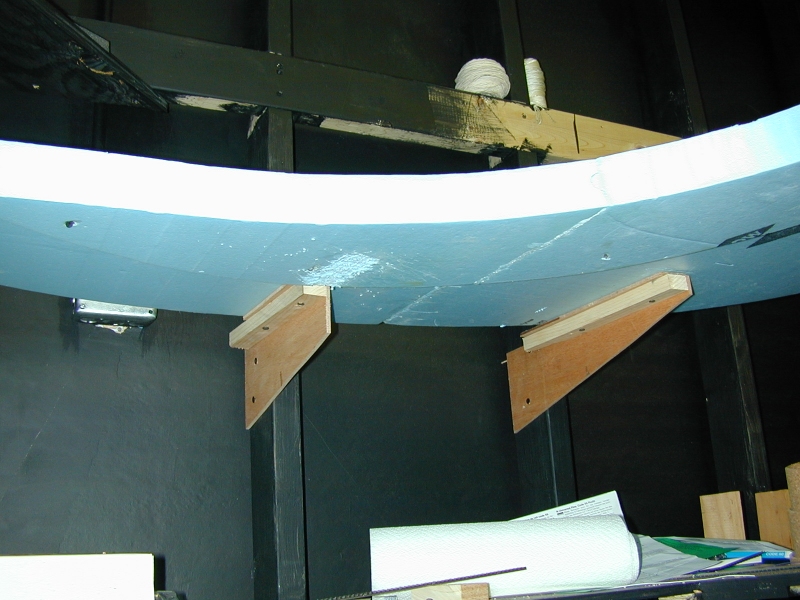
| Here is the underside of the Mascoma section to show how
the luan plywood is used to hold the foam in place. |
 |
| Here's how the bracing works. This is primarily
held using ACC glue formulated for foam. It's incredible stuff! |
 |
| This image shows the staging yard below and the area on
the second level representing Lebanon, NH. Here is where the station
and freight depot will be located. |
 |
| This corner shot shows level two where Lebanon continues
with the Mascoma river (the cut section). The tannery and Riverside
Mill will be located here along the river. |
 |
I will continue to update this page as new construction progresses. If you're in
White River Junction, VT on a Tuesday or Thursday evening, stop by and say hello and see
the progress in person!